
Blog / News Details
18 September
2026
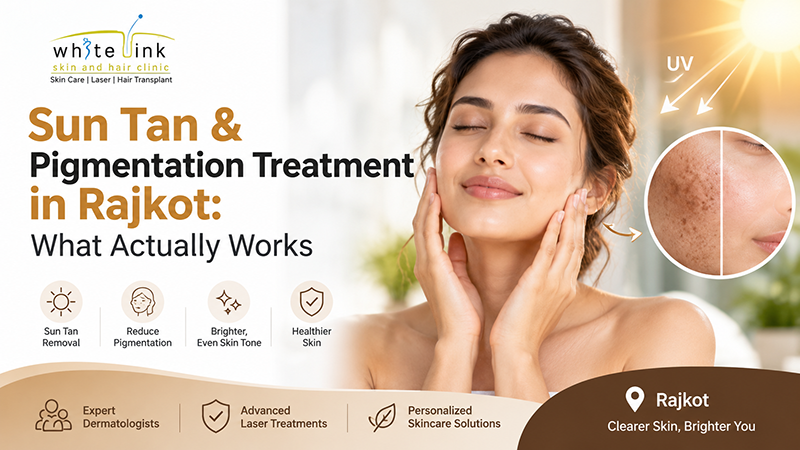
Sun Tan & Pigmentation Treatment in Rajkot: What Actually Works
Introduction
Do you find yourself avoiding the sun because you're scared of getting even more tanned? Or maybe you've got dark patches on your cheeks or forehead that just refuse to go away, no matter what cream you try?
If this sounds familiar, you're definitely not the only one. Living in Rajkot, where the sun is out in full force most of the year, sun tan and pigmentation are two of the most common things people come to us for.
The good part is, this can actually be treated. With the right pigmentation treatment in Rajkot, most people see a real, visible difference. At White Ink, we've helped a lot of patients get their skin tone back to looking clear and even — and in this blog, we'll explain exactly how.
What is Skin Pigmentation & Sun Tan?
Let's break this down simply, without the jargon.
Your skin has something called melanin — it's basically the pigment that gives your skin its colour. When you step out in the sun, your skin makes more melanin to protect itself. That's what causes tanning.
Pigmentation is a bit different. Instead of the melanin spreading evenly, it starts clustering in certain spots. That's what shows up as dark patches, spots, or uneven colour on your skin.
Here's the key difference — sun tan usually fades on its own after some time. Pigmentation is more stubborn. It often sticks around unless it's treated properly, which is where seeing a skin specialist in Rajkot really helps.
Common Causes of Sun Tan & Pigmentation
Before we talk about treatment, it's worth understanding why this happens in the first place. It's usually not just "too much sun" — there's more to it.
Excess Sun Exposure (UV Rays)
This is the main reason for most people. UV rays push your skin to make extra melanin, which leads to tanning first and, over time, pigmentation. Even daily travel, standing near a window, or working outdoors adds up more than people realise.
Hormonal Changes & Melasma
A lot of women deal with a specific kind of pigmentation called melasma. It's usually linked to pregnancy, birth control pills, or general hormonal changes, and shows up as brown patches on the cheeks, forehead, or above the lips.
Pollution & Ageing
As we get older, our skin doesn't repair itself as quickly as before, so pigmentation tends to show up more easily. Add pollution on top of that, and your skin is under constant stress, which makes dark spots harder to manage.
Improper Skincare / No Sunscreen Use
This one's simple, but it's the most overlooked. If you're skipping sunscreen or not following any real skincare routine, your skin stays unprotected — and that makes tanning and pigmentation worse over time.
Benefits of Professional Pigmentation Treatment at ‘White Ink’
Home remedies and random creams can only take you so far. Here's why going for a proper pigmentation removal treatment actually makes a difference.
Even & Brighter Skin Tone
Professional treatments work deeper than surface-level remedies. Many patients notice their skin looking more even and brighter within a few sessions.
Long-Lasting Results vs Home Remedies
Kitchen remedies might feel comforting, but the results are usually temporary and inconsistent. A proper clinical treatment tends to give results that last much longer.
Safe, Dermatologist-Guided Treatment
Every treatment plan at White Ink is created and supervised by trained skin experts. Nothing is random — it's based on what your skin specifically needs.
Boosts Confidence
There's a real difference in how you feel when you're not constantly hiding patches under makeup or worrying about how your skin looks in photos. Clearer skin often brings back a bit of confidence you didn't realise you were missing.
Not sure which treatment would suit your skin best? That's completely normal — most patients aren't. Come talk to our team at ‘White Ink’, and we'll help you figure out what's right for you.
White Ink's Approach to Sun Tan & Pigmentation Treatment
Every patient's skin is different, so we don't believe in giving everyone the same treatment. Your skin is looked at individually before we suggest anything.
Treatment Options Used
Depending on your skin type and how deep the pigmentation is, we may suggest:
- Chemical peels, to gently exfoliate and fade dark spots
- Laser skin treatment in Rajkot, for more precise, targeted pigmentation removal
- Skin brightening therapies, to even out tone and bring back some natural glow
Sometimes it's just one of these, sometimes a mix — it really depends on what your skin needs.
Why Choose ‘White Ink’ in Rajkot
We try to combine good technology with genuine, one-on-one attention. Under Dr. Tejas Ramani's guidance, treatments are planned around you specifically, so what you get is real results, not just reassurance.
What to Expect During the Treatment Process
If you're a bit nervous about what actually happens in a session, here's how it usually goes, step by step.
- Consultation & Skin Analysis — We take a close look at your skin to understand what type of pigmentation you have and how deep it goes.
- Customised Treatment Plan — Based on that, we suggest a treatment, or sometimes a mix of a few, that fits your skin.
- The Procedure — Most sessions are quick and fairly comfortable. You might feel slight warmth or tingling, but nothing that's hard to manage.
- Post-Treatment Guidance — Before you leave, we'll walk you through exactly how to take care of your skin at home.
- Follow-Up Sessions — Depending on how your skin responds, a few follow-up visits are usually recommended to get the best outcome.
We try to make the whole process as simple and stress-free as we can.
Aftercare & Sun Protection Tips
Getting the treatment done is only half the work. What you do afterward matters just as much.
- Use a good sunscreen (SPF 30 or above) every day.
- Try to avoid direct sun, especially between 11 AM and 4 PM
- Keep your skin moisturised so it can heal properly
- Skip harsh scrubs or strong actives unless your doctor tells you it's okay
- Stick to any follow-up sessions or home-care routine your doctor recommends
Honestly, most cases of pigmentation coming back happen because this part gets skipped. So it's worth taking seriously.
Why Choose ‘White Ink’ in Rajkot?
There's no shortage of clinics in Rajkot offering skin treatments, so what makes patients choose White Ink for their pigmentation concerns?
- Real experience — Dr. Tejas Ramani has been practicing since 2009, and that experience shows in how treatment plans are handled
- Plans made for you — No copy-paste packages, your treatment is built around your actual skin
- Good technology — From laser treatments to newer skin brightening options, we keep up with what's genuinely working
- Hygiene that's taken seriously — Strict hygiene practices are followed at every step, so you never have to worry
- A team that listens — Your questions and concerns are always given proper time, nothing feels rushed
It's really this mix of experience, the right technology, and actually caring about the patient that keeps people coming back to ‘White Ink’ for sun tan removal treatment and pigmentation care.
Frequently Asked Questions
1. How many sessions are needed to remove sun tan or pigmentation?
It depends on the person. Mild sun tan can often improve in a few sessions, but deeper pigmentation usually needs multiple sessions spaced a few weeks apart.
2. Is pigmentation treatment safe for sensitive skin?
Yes, most treatments can be adjusted for sensitive skin. We always check your skin type first at ‘White Ink’ so the treatment suits you specifically.
3. Can pigmentation come back after treatment?
It can, especially if you skip sunscreen or spend a lot of time in the sun afterward. Sticking to the aftercare advice really lowers the chances of it returning.
4. What is the difference between sun tan and pigmentation?
Sun tan is usually temporary and fades on its own in a few weeks. Pigmentation is deeper and more stubborn, and generally needs proper treatment to clear up.
5. Do I need to avoid sun exposure after the treatment?
Yes, definitely. Your skin is more sensitive right after treatment, so sunscreen and limiting sun exposure for a while is important.
Conclusion
You don't really have to just live with sun tan or pigmentation forever. With the right treatment and a bit of consistency on your end, clearer, more even skin is very much possible.
If you've been putting this off, consider this your nudge to stop waiting. Whether it's stubborn tan or dark patches that have been around for years, the right pigmentation treatment in Rajkot might be closer than you think — and it starts with just one conversation.